
Insights
What we check before a listing goes live
Published 8 October 2026
Every listing on payxem.shop is read by a person before it appears. Nothing publishes automatically and nothing skips the queue. That is slower for a seller than pressing publish, and it is the reason the catalogue is worth browsing at all.
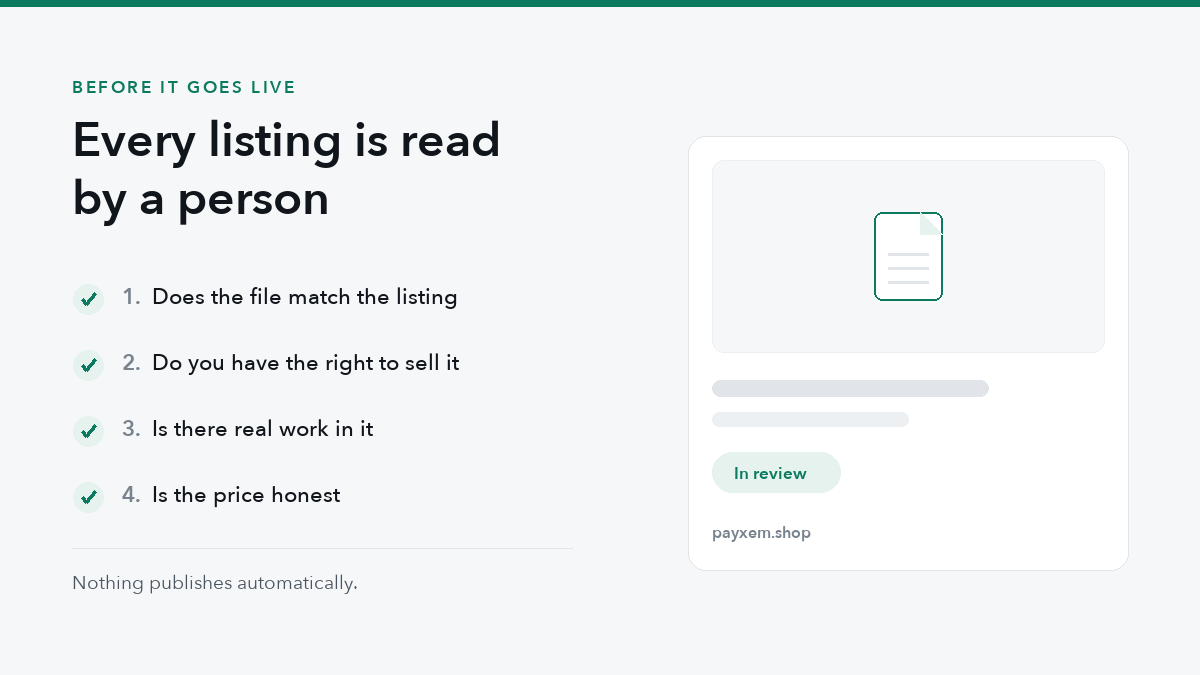
The four questions
Sellers ask us what we are looking for. The honest answer is four questions, asked in this order.
Does the file match the listing
A buyer cannot pick up a digital file and turn it over. They have a title, a description, a few images and a price, and then they pay. So the first thing we do is open the file and read the listing beside it.
What sends a listing back here is usually small and specific. A page count that does not match. A feature named in the description that is not in the file. Screenshots taken from a different version of the product. A bundle sold as five templates that turns out to hold three.
Do you have the right to sell it
Every uploaded file is fingerprinted. A file already being sold by a different seller is refused at the point of upload, before a person ever sees it. Your work cannot be quietly relisted by somebody else, and you cannot relist theirs.
Past that check we look at what sits inside the product. Fonts, icons, photographs, code and datasets all carry licences of their own, and a licence that allows you to use something is not the same as a licence that allows you to sell the result. If your product includes somebody else's material, hold the licence that covers the way you are actually using it.
Is there real work in it
We refuse products that are functionally empty. A one page file sold as a course. A link to a free resource. A file whose only real content is a promise of something arriving later. Bulk generated filler listed at volume.
This is the category that surprises people most, because none of it is illegal. It is simply not what this marketplace is for.
Is the price honest
You set your own price, and your seller dashboard shows the range available to your store. The part we check is the reference price, the one shown with a line through it beside the current price. That has to be a price you genuinely sell at or have sold at in the past. A number invented to manufacture a discount gets removed.
If something is wrong
We can approve a listing, ask for changes, or reject it. When we reject something, or take a published listing back down, we tell you which rule it fell on. You fix it and submit again. Being sent back once is an ordinary part of listing and it does not count against your store.
A smaller set of things is refused outright rather than sent back: anything built to deceive, pirated or cracked software, scraped personal data, exam answers, and products promising guaranteed financial returns. Repeated attempts close the store. The full list sits under what you cannot list.
What the review is not
A review is a check, not a guarantee, and it does not move responsibility for a product from the seller to us. We read for the things a buyer cannot see before paying. We are not auditing the formulas in your spreadsheet or verifying every claim you make about a government process.
Two more things happen quietly in the background. Paid files sit in private storage and are released only against a real purchase, so nothing you upload is ever sitting on a public link. And a product file is currently capped at 25 MB, so anything larger needs splitting until the bigger upload path is finished.
Common questions
Can a listing go live without review?
No. Every listing is read by a person first, and nothing publishes automatically.
What happens if my listing is rejected?
We tell you which rule it fell on. You can fix it and submit it again, and one rejection does not count against your store.
Can another seller list a file I already sell?
No. The fingerprint check refuses a file that another seller is already selling, at the moment it is uploaded.
Does a review mean you stand behind the product?
No. It is a check rather than a guarantee, and responsibility for the product stays with the seller who made it. The detail is in the seller agreement.